
Head of the research group
CHOUA Sylvie
Professeureà l'Unistra
Year of creation of the group - 2007
CHOUA Sylvie
Professeureà l'Unistra
Year of creation of the group - 2007
Le Bel Institute, 8th floor North
STOLL Geneviève
email: genstoll[at]unistra.fr
Phone: +33 (0)3 68 85 13 64
The team is made up of (bio) physicists, physico-chemists, and organic chemists experimenters whose research topics are:
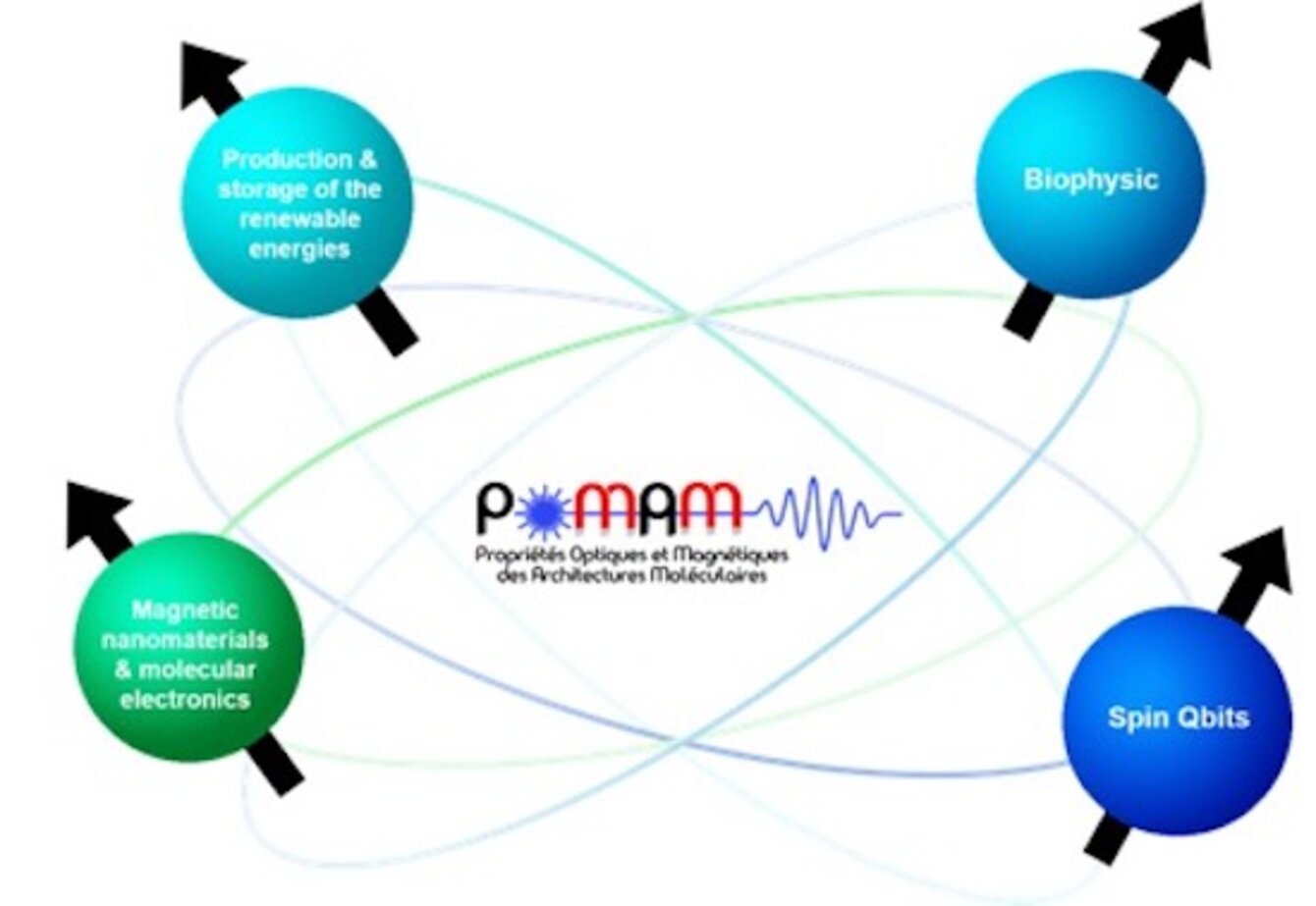
¤ Electron Paramagnetic Resonance Spectroscopies
¤ Molecular Orbital Calculation Methods of Functional Density Type (DFT)
¤ Systems of studies:
Node of the Research Infrastructure (IR 3443) EPR of the CNRS 'Renard', registered in the 'Large Equipments / Large Research Infrastructures' of the CNRS: http://renard.univ-lille1.fr/. The laboratory answers via this platform to the requests for EPR analysis in fluid, or frozen solution, on support or on single-crystal. Experiments are adapted and optimized for diverse recording support.
For further information, contact the person in charge of the platform Nolwenn Le Breton and visit the POMAM laboratory website: https://pomam.chimie.unistra.fr/
email : nlebreton[at]unistra.fr
Phone : +33 (0)3 68 85 16 31
Y. Port-Lougarre, C. Gourlaouen, B. Vileno, E. Giménez-Arnau
Antioxidant activity and skin sensitization of eugenol and isoeugenol: two sides of the same coin?
Chem Res Toxicol, 2023, 36 (11), 1804-1813. DOI: 10.1021/acs.chemrestox.3c00263
B. Vileno, Y. Port-Lougarre, E. Giménez-Arnau
Electron paramagnetic resonance and spin trapping to detect free radicals from sensitizing xenobiotics in contact with the skin: from the molecule to the tissue
Contact Dermatitis2022, 86 (4), 241-253. DOI: 10.1111/cod.14037
E. Di Piazza, C. Boilleau, A. Vacher, K. Merahi, L. Norel, K. Costuas, T. Roisnel, S. Choua, P. Turek, S. Rigaut
Ruthenium carbon-rich group as a redox-switchable metal coupling unit in linear trinuclear complexes
Inorg. Chem., 2017, 56(23), 14540-14555
C. Fliedel, V. Rosa, B. Vileno, N. Parizel, S. Choua, C. Gourlaouen, P. Rosa, P. Turek, P. Braunstein
Zwitterionic Cobalt Complexes with Bis(diphenylphosphino)(N-thioether)amine Assembling Ligands: Structural, EPR, Magnetic, and Computational Studies
Inorg. Chem.,2016, 55(9), 4183-4198
A. K. Boudalis, G. Rogez, B. Heinrich, R. G. Raptis, P. Turek
Towards ionic liquids with tailored magnetic properties: bmim+ salts of ferro- and antiferromagnetic CuII3 triangles
Dalton Trans., 2017, 46, 12263-12273
![[Translate to English:]](/websites/_processed_/0/4/csm_signature-unistra_16a9ad672e.png)
![[Translate to English:]](/websites/_processed_/0/e/csm_logo-cnrs_c35686510a.png)
![[Translate to English:]](/websites/_processed_/9/4/csm_logo-fondation-lehn_e04fdb6c72.png)