
Abstract
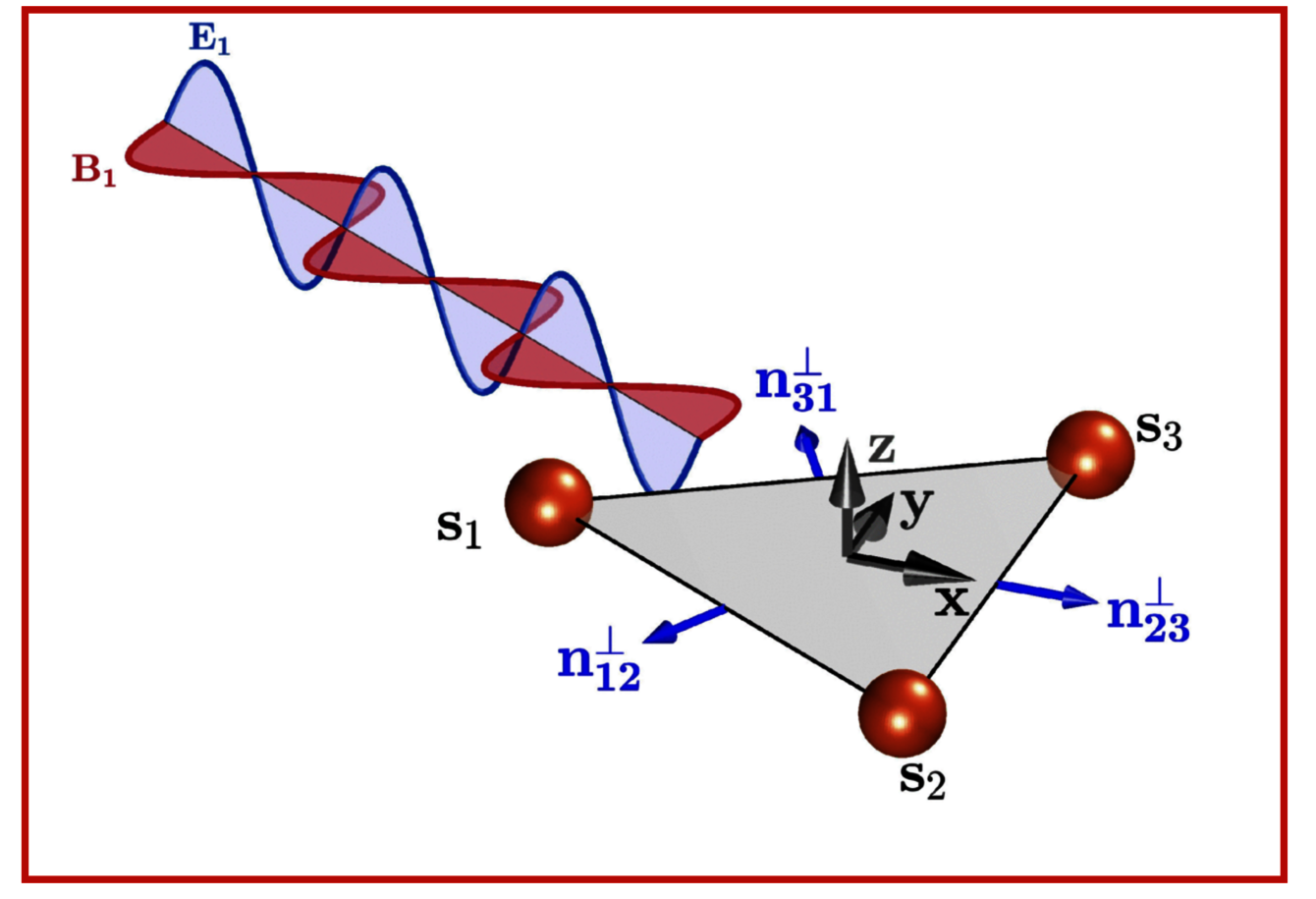
Quasi-optical experiments are emerging as a powerful technique to probe magnetic transitions in molecular spin systems. However, the simultaneous presence of the electric- and magnetic-dipole induced transitions poses the challenge of discriminating between these two contributions. In addition, the identification of the spin-electron transitions can hardly rely on the peak intensity because of the current uncertainties on the value of the spin-electric coupling in most molecular compounds. Here, we compute the polarizations required for electric- and magnetic-dipole induced transitions through spin-Hamiltonian models of molecular spin triangles. We show that the polarization allows a clear discrimination between the two kinds of transitions. In addition, it allows one to identify the physical origin of the zero-field splitting in the ground multiplet, a debated issue with significant implications on the coherence properties of the spin qubit implemented in molecular spin triangles.
Reference
Polarization dependence of spin-electric transitions in molecular exchange qubits
Filippo Troiani & Athanassios K. Boudalis
Physical Review B, 113, 075409 – Published 6 February, 2026 – DOI :https://doi.org/10.1103/nfxt-sfg2
Contact
Athanassios K. Boudalis, team POMAM, Institut de Chimie de Strasbourg (UMR 7177).

![[Translate to English:]](/websites/_processed_/0/4/csm_signature-unistra_fee3442f1d.png)
![[Translate to English:]](/websites/_processed_/0/e/csm_logo-cnrs_c0f610620b.png)
![[Translate to English:]](/websites/_processed_/9/4/csm_logo-fondation-lehn_24043a5484.png)