Abstract
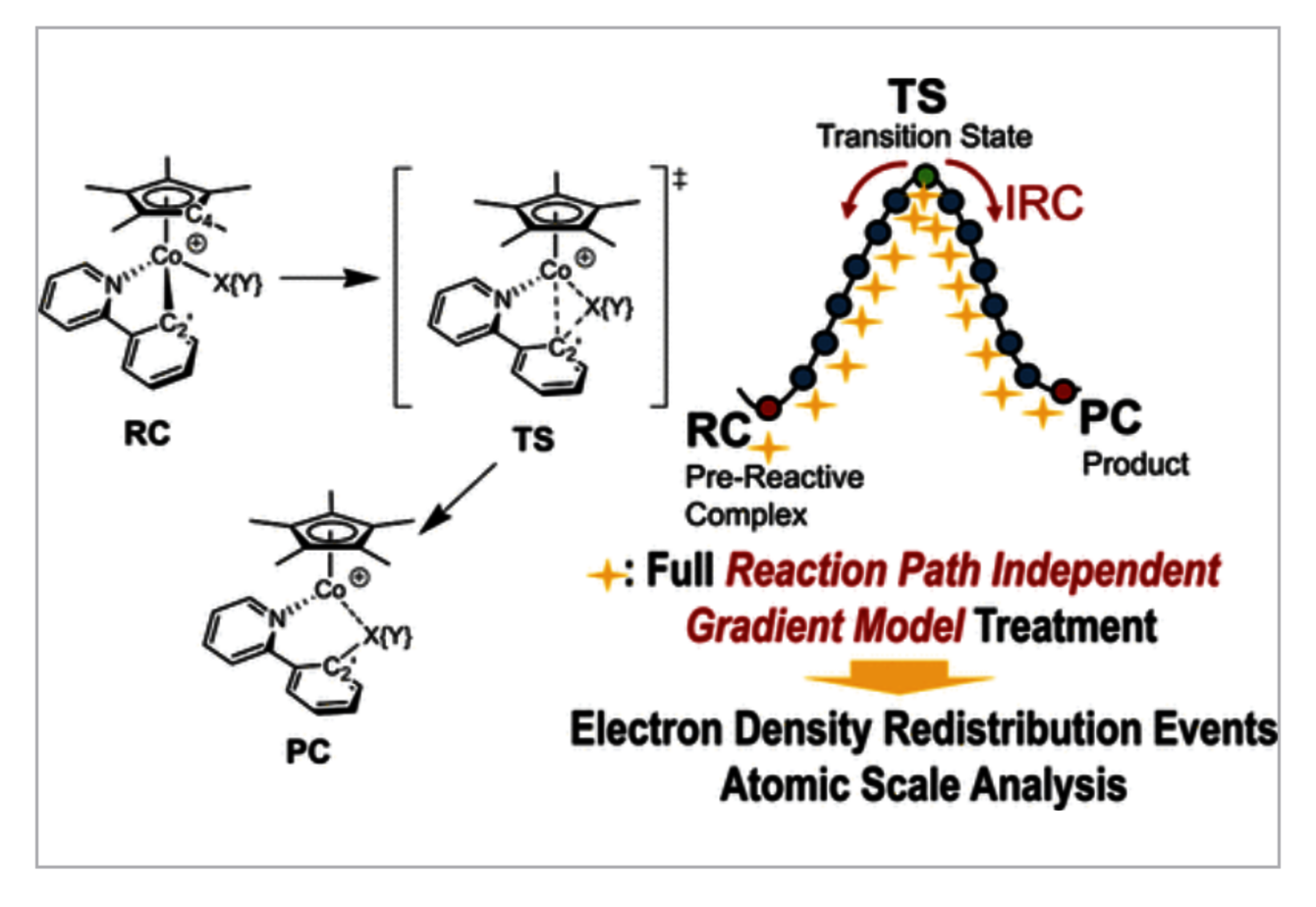
The Independent Gradient Model (IGM) reveals interaction signatures by analyzing the electron density (ED) gradient. In this report it is used to analyze the variations of the electronic structure of a molecular system undergoing, along a series of highly sampled Intrinsic Reaction Coordinates (IRC), a concerted reductive elimination reaction staging a doublet ground state metallacyclic [Cp*{C,N}CoIV(X{Y})]+ (X{Y} = 1 electron ligand, {Y} = assisting atom) prereactive complex (RC). The IGM interfragment Δginter score and the degree of interaction (DOI(Co)) of the cobalt center reveal meaningful electronic changes occurring during the reaction, which inform of the active interactions of the ligands with the metal: the Cp* ligand intervenes in the reductive-elimination reaction as an ED reservoir supplementing the Co center. The sourcing of atomic contributions of peripheral atoms to the changes of DOI(Co) at valleys and peaks of DOI reveals, in a nonintuitive way, the role of cobalt’s ligands when the system passes through remarkable transient structures. The peaks of DOI either precede or follow the transition state (TS) and are similar to σ-complex structures, suggesting, counterintuitively, that significant electronic changes do not occur at the TS.
Reference
Dissecting Reaction Paths with the Independent Gradient Model: The Case of a Key Reductive Elimination Step at Cobalt(IV)
Sara Figueirêdo de Alcântara Morais, Lucas Loir-Mongazon, Cornaton Yann, Eric Hénon, Jean-Pierre Djukic
The Journal of Physical Chemistry A, Published February 6, 2026 – DOI : https://pubs.acs.org/doi/pdf/10.1021/acs.jpca.5c06549
Contact
, team LCSOM, Institut de Chimie de Strasbourg, UMR 7177.