Abstract
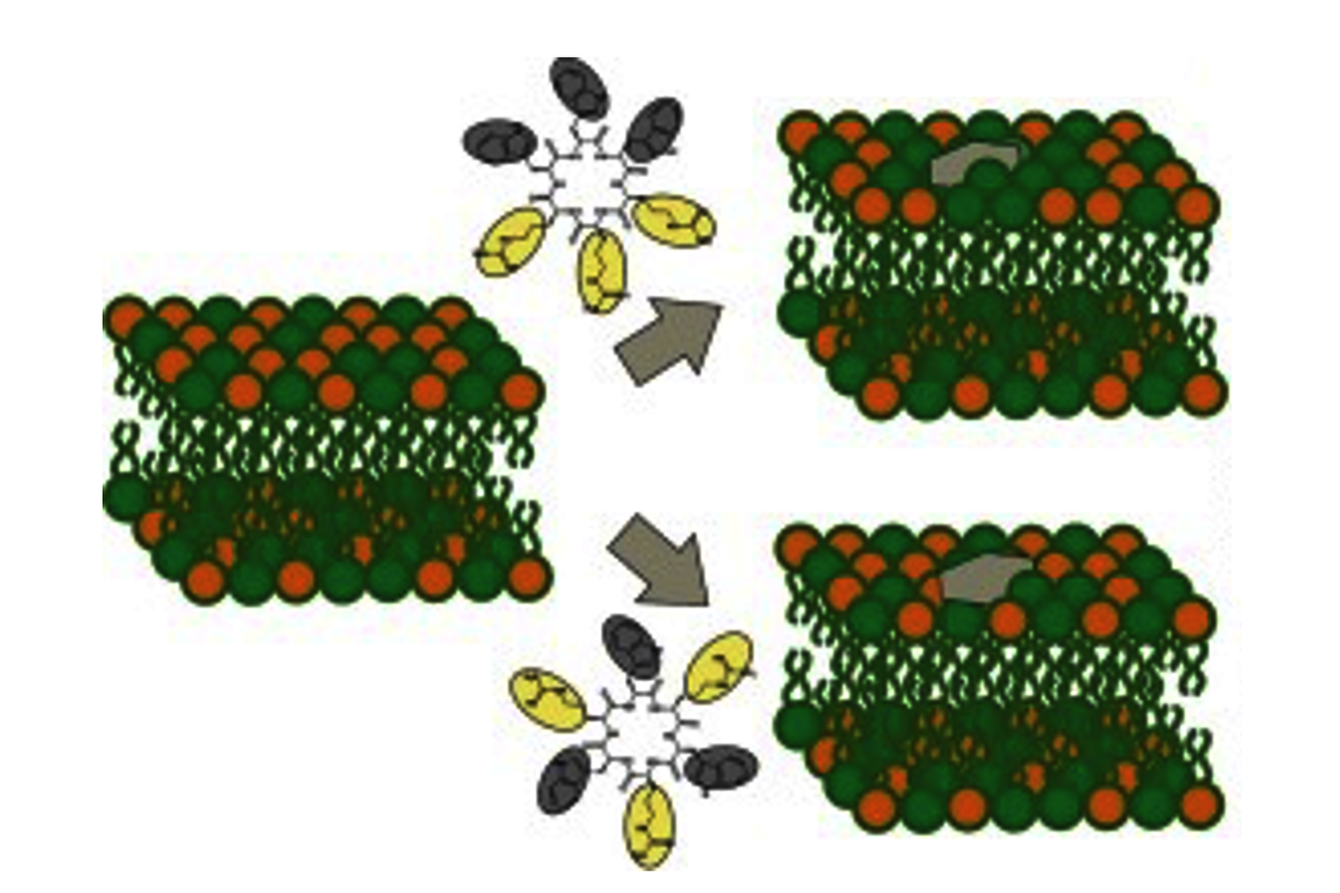
Antimicrobial peptides (AMPs) are hoped to complement classical antibiotics in view of increasing microbial resistance. We investigated two members of a family of designed cyclic AMPs with different activity and selectivity. The cyclic hexapeptides are rich in arginine and tryptophan and have been shown previously to target cell membranes and to affect model membranes differently depending on the lipid membrane composition.
To better understand their mechanisms of membrane perturbation, we investigated the interactions of cyclic RRRWWW and cyclic RWRWRW with various model membranes containing lipids commonly found in either bacterial or eukaryotic membranes. Using 31P and 2H solid-state NMR methods, we systematically analyzed the interactions between the peptides and lipid membranes at the molecular level. When POPE/POPG model membranes are investigated the two peptides exhibit distinct interactions with the PE and PG components, reflected in a different decrease in lipid chain order parameters. This decrease in deuterium order parameters and deformation of the vesicle shapes indicate disturbance of the lipid membrane structure by the peptides. Our study provides new insights into the molecular mechanisms of AMP-membrane interactions and can contribute to the understanding and development of novel antimicrobial agents.
Reference
Membrane interactions of designed cyclic RW peptides by solid-state NMR spectroscopy
Kathakali De, Christopher Aisenbrey, Maria Hoernke, Burkhard Bechinger
BBA – Biomembranes, Volume 1868, Issue 3, July 2026, 184519 – DOI : https://doi.org/10.1016/j.bbamem.2026.184519
Contact
Burkahrd Bechinger (team Biophysique des membranes et RMN), Institut de chimie de Strasbourg, UMR 7177.