Abstract
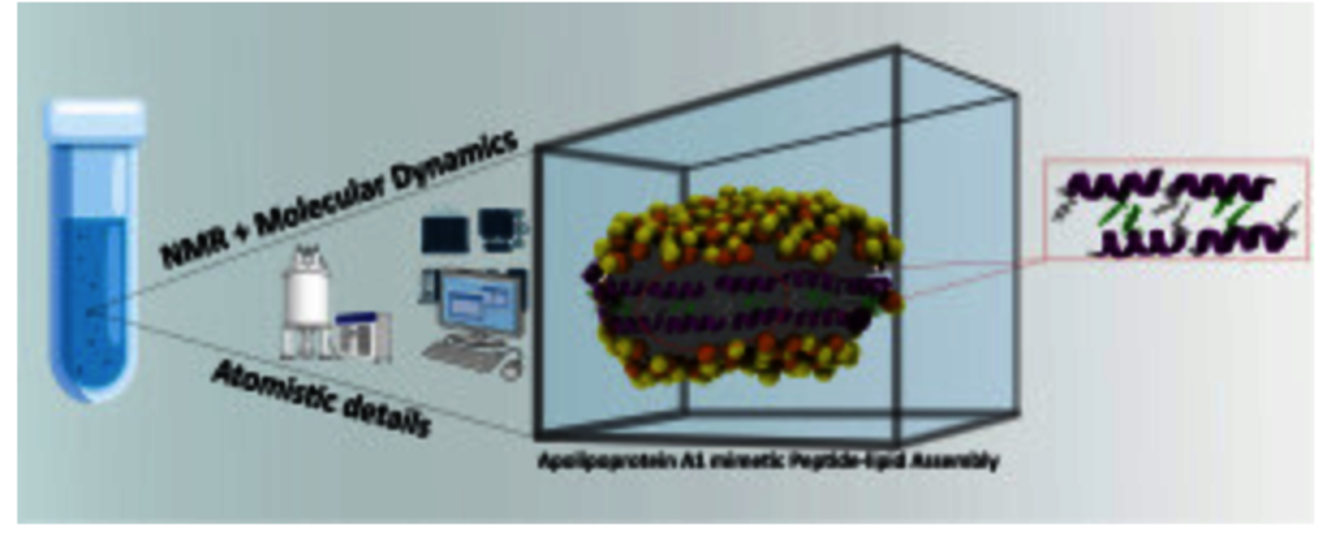
Apolipoprotein A-I (apoA-I) mimetic peptides, inspired by the principal protein component of high-density lipoprotein, self-assemble with lipids to form discoidal nanodiscs widely used in biomedical research and as versatile scaffolds for characterization of membrane proteins in structural biology. Here, we investigate the 14A apoA-I mimetic, quantifying its orientation around the lipid bilayer and identifying the interactions that are crucial for nanodisc stability and dynamics using all-atom molecular dynamics simulations. To assess model fidelity, we back-calculated solid-state NMR observables, namely 15N chemical shifts and 2H quadrupolar splittings from the trajectories and compared them with previously reported solid-state NMR data. The simulations support a dimeric, antiparallel, belt-like arrangement of 14A peptides around the discoidal bilayer, stabilized by π-π stacking between aromatic residues and by electrostatic and hydrophobic peptide–lipid interactions. These interactions yield structurally stable nanodiscs with pronounced heterogeneity in lipid ordering and bilayer thickness between the nanodisc center and rim. Collectively, our MD results provide atomistic evidence for previously hypothesized peptide–peptide and peptide–lipid interactions and clarify how amphipathic helices organize to form the rim of discoidal nanodiscs. These insights inform the rational design of apoA-I mimetics for biomedical applications and the optimization of nanodiscs as platforms for studying membrane proteins.
Reference
Structural and dynamics of apoA-1 mimetic peptide lipid nanodisc assemblies: A molecular dynamics study
Biochimica et Biophysica Acta (BBA) – Biomembranes, 2025, 1868(2):184495 - DOI: 10.1016/j.bbamem.2025.184495
Contact
Burkahrd Bechinger (team Biophysique des membranes et RMN), Institut de chimie de Strasbourg, UMR 7177.